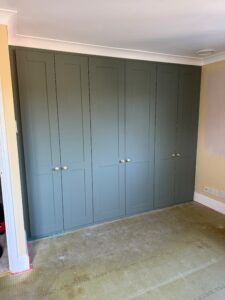
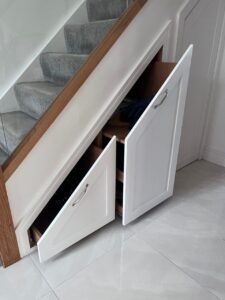
Choosing built-in bedroom storage starts with much more than picking a colour or door style. The most successful designs consider how much you need to store, how you use your clothes each day, available dimensions, access, lighting and the shape of the area.
This bespoke wardrobe guide explains how to choose fitted wardrobes by working through those decisions in the right order. You will learn how to assess your available area, plan useful internal storage, compare hinged and sliding doors, choose finishes and recognise when made-to-measure furniture could solve an awkward layout.
What Should You Consider Before Choosing Fitted Wardrobes?
Before looking at finishes or handles, think about what the furniture actually needs to achieve.
Which? recommends beginning with your budget, measuring carefully, creating the internal layout and only then choosing the external style. Its UK buying advice also recommends noting fixed features such as windows, doors, plug sockets, switches and radiators when planning an installation.
Starting Checklist
-
✓ Measure the full height and width available.
-
✓ Identify sloping ceilings, alcoves and uneven walls.
-
✓ Note sockets, switches, radiators and other fixed features.
-
✓ Check how doors, beds and other furniture affect access.
-
✓ List everything you expect the storage to hold.
-
✓ Consider whether your requirements may change over time.
The more accurately these details are considered at the beginning, the easier it is to produce an efficient layout.
How Do You Plan the Inside Before Choosing the Outside?
One of the most useful pieces of fitted wardrobes advice is to work from the inside out.
Think about what currently causes clutter. Do you have too many clothes on one rail? Are shoes difficult to organise? Would drawers allow you to remove a separate chest of drawers?
• Full-height hanging for dresses, coats and longer garments.
• Double rails for shirts, trousers and shorter clothing.
• Internal drawers for underwear, accessories and folded items.
• Shelving for knitwear, bags and storage boxes.
• Shoe storage to keep footwear organised and accessible.
• High-level sections for luggage, bedding and seasonal belongings.
• Pull-down rails where taller sections would otherwise be difficult to reach.
Which?’s current UK advice similarly recommends assessing long garments, shoes, bags and folded clothes before deciding how the interior should be divided.
Should You Choose Sliding or Hinged Doors?
The correct door type depends on available clearance and how you want to access your belongings.
When Are Sliding Doors a Good Choice?
Sliding doors move across the front rather than opening into the bedroom. They can therefore be practical where the bed or other furniture sits relatively close to the installation.
They can also accommodate mirrored panels, which may reduce the need for a separate full-length mirror.
However, sliding systems normally mean that part of the interior remains covered when another section is open. Which? specifically recommends considering this access limitation before selecting them purely to save clearance.
When Do Hinged Doors Work Better?
Hinged doors can provide direct access to a larger proportion of the interior at the same time. They also work particularly well with internal drawers, accessories and storage positioned directly behind each opening.
They need enough clearance to swing comfortably, so bed position, bedside furniture and walking routes should be considered first.
How Can Fitted Furniture Make Better Use of an Awkward Area?
Standard furniture works best in straightforward layouts. Homes do not always provide them.
Loft bedrooms, chimney breasts, alcoves, sloping ceilings and unusual corners can leave areas that conventional units cannot use efficiently. Which? specifically highlights small bedrooms, awkward alcoves and sloping ceilings as situations where built-in storage can be particularly effective.
For example, lower sections beneath an angled ceiling might hold drawers or shoes, while the taller portion provides hanging storage. Alcoves can be taken closer to full height and width rather than leaving unusable gaps around freestanding furniture.
B Bespoke Wardrobes regularly designs furniture around these challenges. Its dedicated awkward spaces service includes solutions for angled ceilings, lofts, alcoves and other difficult layouts.
What Can a Real Installation Tell You About Good Planning?
Real projects are useful because they show how design decisions solve specific problems rather than simply looking attractive in a showroom.
One B Bespoke project involved replacing an outdated installation and removing surrounding stud walls. The resulting four-door sliding design was built to almost one metre deep and included five extra-deep soft-close drawers. The central doors helped maintain a brighter feel while the increased depth created substantially more storage. Read more in our South Woodham Ferrers installation case study.
That example demonstrates an important principle. The correct solution is not necessarily a standard depth, door arrangement or internal configuration. It depends on what the property allows and what the homeowner wants to store.
How Should You Choose Colours and Finishes?
Once the practical layout has been established, you can concentrate on appearance. Start by considering:
-
✔ Natural light available during the day.
-
✔ Wall colours and whether you want contrast or continuity.
-
✔ Flooring, including timber, carpet or neutral finishes.
-
✔ Existing furniture that will remain after installation.
-
✔ Overall style, such as contemporary, traditional or minimalist.
Lighter finishes can create a quieter appearance in compact bedrooms, while darker shades can form a stronger feature where there is sufficient light.
Woodgrain effects can introduce warmth and texture without requiring a heavily decorative design.
What Mistakes Should You Avoid When Choosing Fitted Wardrobes?
Understanding how to choose fitted wardrobes also means knowing what commonly goes wrong.